
A wine cooler can recover slowly after a door is left open or a large number of bottles are loaded at once. Patience is reasonable after a known event. It is not a diagnosis when the same temperature drift keeps…
A wine cooler needs real diagnosis when the same temperature drift keeps returning under stable conditions, or when a fan, frost pattern, alarm or compressor cycle changes. Patience fits a known event such as a long open door or a big load. Rule out the owner-level causes below first, then book service with the readings you collected.
A wine cooler can recover slowly after a door is left open or a large number of bottles are loaded at once. Patience is reasonable after a known event. It is not a diagnosis when the same temperature drift keeps returning.
Start with evidence. Measure the actual temperature, record the setpoint and note whether the issue affects one zone or the entire cabinet. Confirm the door seals and the built-in ventilation openings are clear. Those checks are covered in Wine Doesn’t Forgive a Warm Week — Checking a Drifting Wine Cooler.
The user manual for one Bertazzoni wine column lists the checks for a cabinet running warmer than normal: look for a malfunction code, confirm the temperature setting is what you intended, clean the condenser, make sure doors were not left open, and consider whether a large load was added recently. It also says that a compressor running for a long time in a hot room is normal. If those explanations do not fit and the temperature still does not come back, the problem is no longer a matter of waiting.
The display can help as well. Messages on that model include a power failure notice, a door open warning and zone too warm or too cold messages, plus error codes that appear when you touch Alarm. The manual then says to contact customer care, so a code on the screen is more useful to a technician than a description of the cabinet feeling warm.
Service becomes the sensible next step when the cabinet cannot hold temperature under stable conditions, a fan becomes noisy or stops, frost develops abnormally, an alarm returns, or the compressor seems to start and stop repeatedly. A cabinet that cools normally for a day and then warms again is giving you a pattern worth describing when you call.
The table below pairs common observations with what they can suggest and what you can safely check.
| Symptom | What it can point to | What you can safely check |
|---|---|---|
| Warm after a big load or open door, recovering slowly | A known event rather than a fault | Leave the setting alone and allow time to settle |
| Temperature higher than normal with no recent event | Setting, condenser, door sealing or a cooling fault | Confirm the setpoint, clean the accessible condenser area, check the gasket |
| One zone warm while the other is fine | A zone-specific issue rather than a whole-cabinet one | Compare both zones with a thermometer and note which is affected |
| Fan noise changes or stops | A fan or control problem | Stop investigating; do not open panels |
| Frost appearing where it did not before | An airflow or defrost-related fault | Avoid scraping; request service |
| Alarm returns after being cleared | A fault the control keeps detecting | Touch Alarm to read the code and contact service |
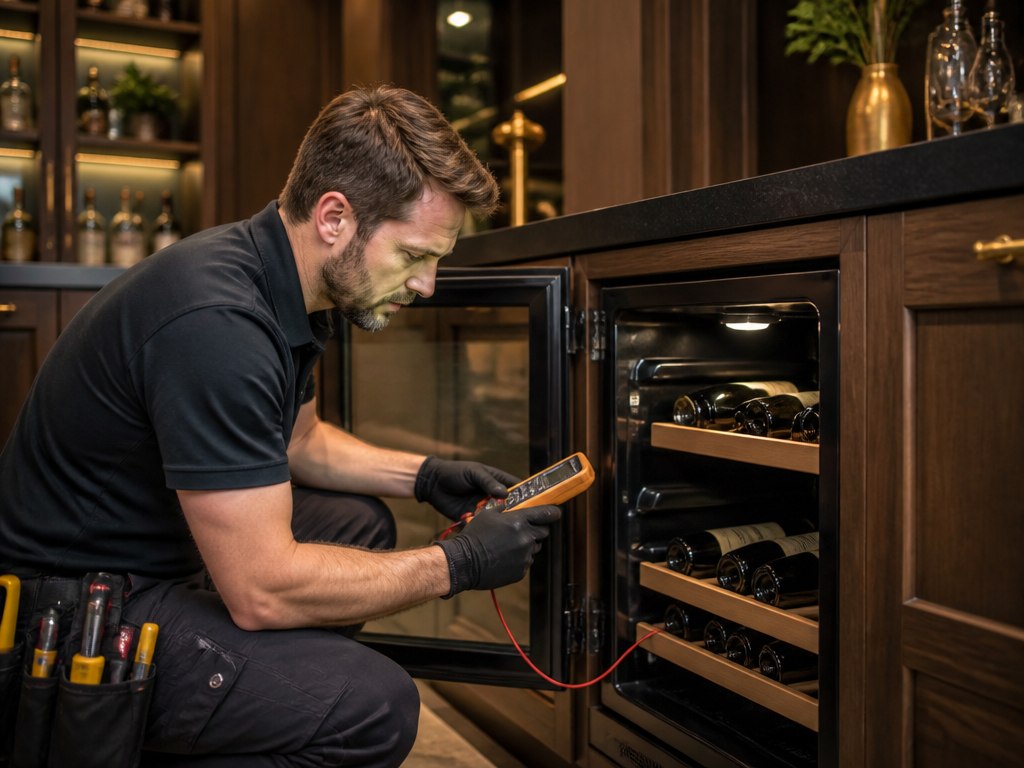
A technician may compare sensor readings with actual temperature, verify fan operation, evaluate control commands and assess cooling performance. Those measurements answer questions that cannot be resolved by leaving the unit unplugged overnight or changing the setpoint again.
Avoid removing interior or exterior panels to watch the fans or wiring. Built-in wine columns can have service access that is not obvious from the finished installation.
The same manual says a changed setpoint can take roughly 6 to 12 hours to reach, and that a “too cold” message calls for a 12-hour wait. That gives a practical reference for judging recovery. A cabinet that is still off target well beyond that window, with stable loading and the door closing properly, deserves a service visit.
Leaving the unit unplugged overnight or changing the setpoint again does not answer the question, and each change restarts the settling time. A reading taken under steady conditions is more useful than several readings taken after adjustments.
Stable conditions also mean stable loading. If bottles are being added and removed every day, or the room around a built-in cabinet swings between cool and warm, any reading is hard to interpret. Hold the load and the setting steady for a settling period, measure, and only then decide whether the drift is a pattern.
The checks you can do are mostly about conditions around the cabinet. The questions that remain concern what happens inside the cooling system: whether a sensor reads the true temperature, whether a fan responds when it should, and whether the control commands cooling at the right moments. Those need instruments and access that a finished built-in installation does not offer to an owner.
For routine care that protects airflow and sealing, see Cellar-Like Conditions at Home: Caring for a Built-In Wine Column.
Before the appointment, record the setpoint, actual measured temperature, alarm message, approximate room temperature and whether the problem is constant or intermittent. That gives the technician a timeline rather than a single moment.
Wait through the settling period described in the manual for your model, which for one Bertazzoni column is roughly 6 to 12 hours after a setpoint change. If the cabinet is still off target under stable conditions, book service.
The manual for one model says a long compressor run in a hot room is normal. A long run together with rising temperature, a changed fan sound or an alarm is a different pattern worth reporting.
In the manual for one Bertazzoni column, it is a prompt to clean the condenser area after switching the unit off and waiting about 30 minutes. If the message returns right after cleaning, mention that to service.
Losing cooling, building frost, or pooling water? We diagnose Bertazzoni refrigerator faults and restore reliable, efficient cooling.
Bertazzoni refrigerator diagnostics and repair — cooling loss, frost, leaks and dispenser faults.
Any error codes, how long the compressor runs, and whether the temperature ever reaches the setpoint.
No — repeated resets can erase information that helps a technician diagnose the fault faster.
No, refrigerant systems are sealed and require certified equipment and training to test or service safely.
“Not cold enough” is a useful symptom, but a measured temperature turns it into diagnostic information.
An induction zone needs compatible cookware before it can heat. If the cooktop powers on but one pan is not recognized, the fastest test is often another known-compatible…
An empty ice bin can be caused by something as simple as the ice maker being switched off after cleaning. Before assuming a valve or ice-maker module has…
Share a few details and we’ll confirm an appointment. Prefer to talk? Call us and we’ll help right away.