
“Not cold enough” is a useful symptom, but a measured temperature turns it into diagnostic information.
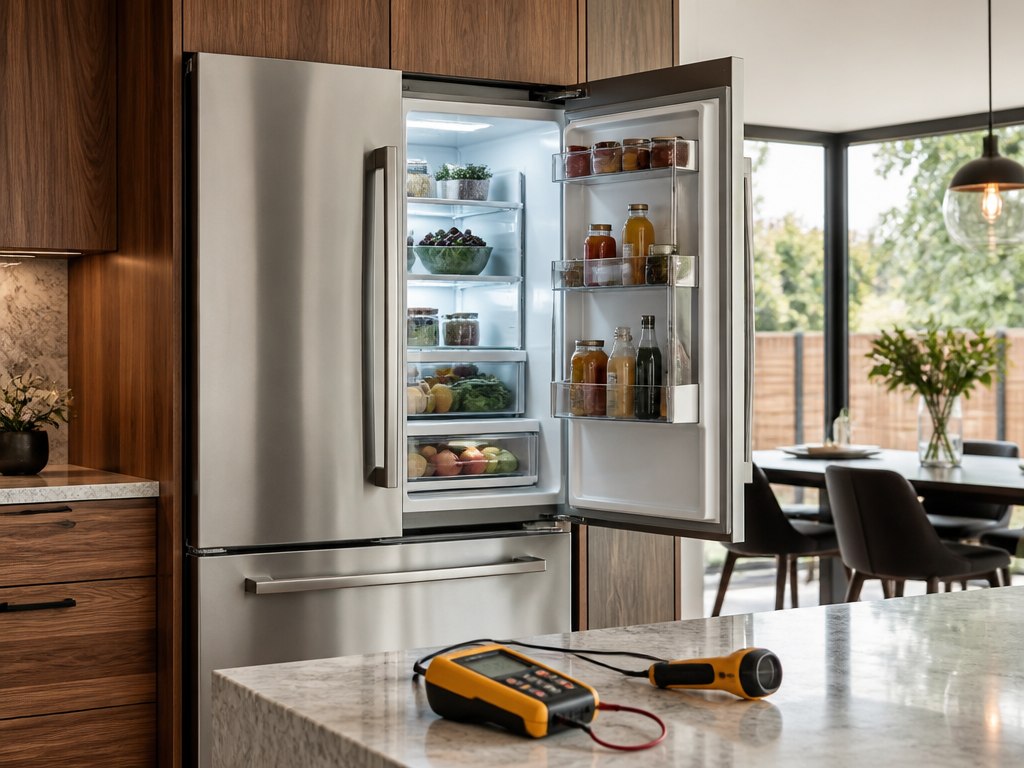
Before booking a fridge repair, put a thermometer in the main compartment, let it stabilize under normal use and compare it with the display setpoint. A reading that returns to a stable range after a grocery load or door opening is not a failure, while one that stays high is the information a technician needs. Measure the freezer separately if it is part of the complaint.
“Not cold enough” is a useful symptom, but a measured temperature turns it into diagnostic information.
Place a reliable refrigerator thermometer in the main compartment, away from the door and direct air outlet. Let it stabilize under normal use. Record the display setpoint and the thermometer reading. If the freezer is part of the complaint, measure it separately rather than assuming both compartments are behaving the same way.
The use manual for one Bertazzoni built-in bottom-mount refrigerator gives a fresh-food range of 35 to 46 F, recommends 39 F and sets 41 F as the factory default. Its Fresco compartment runs from 30 to 41 F with a default of 35 F, and the freezer from 5 to -11 F with a default of 0 F. Your model may differ, so compare your reading with the manual for your own refrigerator.
The manual also says food must not touch the temperature sensor in the fresh-food compartment, or the sensor cannot hold the set temperature, and that hot food should not be put in. A thermometer placed next to a sensor or an air outlet will not match one placed in the middle of a shelf.
Avoid testing immediately after a grocery load, long door opening or power interruption. Those events temporarily change the temperature. What matters is whether the appliance returns to a stable range afterward.
While you wait, inspect the door closure and gasket. Check that food is not blocking visible vents and that built-in ventilation around the appliance is clear. Do not lower the setpoint dramatically in an attempt to “force” the refrigerator colder; that can hide the pattern without repairing the cause.
Several features change temperatures on purpose. In the manual for that series, Super Cool holds 35 F for 24 hours and then reverts, and it suggests activating it 4 to 8 hours before loading a lot of food. Eco Mode sets about 46 F for the fridge and 5 F for the freezer, and Vacation Mode sets the fridge to 62 F. Showroom Mode turns cooling off, so food stays at room temperature until the unit is power-cycled.
For rooms above 86 F, the manual suggests -4 F in the freezer and 37 F in the fridge, and 35 F and -11 F if the fridge is not cold enough from heat or frequent door opening. A setting change like that is not a repair, so check the mode and ambient conditions before concluding the cooling system is at fault.
If the measured temperature stays high, note whether the compressor and fans appear to run, whether there are alarms and whether the problem is constant or cycles between normal and warm. A photo of the display can also help.
The table summarizes what a reading can suggest and what can safely be checked.
| Symptom | What it can point to | What you can safely check |
|---|---|---|
| Reading briefly high after loading or a long door opening | A temporary change from the event | Wait for it to return to a stable range |
| Fridge steady at 41 F | The factory default setting | Compare with the recommended value in the manual |
| Fridge near 62 F or warmer than any normal setting | Vacation Mode or a similar special mode | Check the mode and clear it as described in the manual |
| Food at room temperature, unit seems off | Showroom Mode or a power problem | Check for a mode, then confirm the unit has power |
| Reading stays high while compressor and fans seem to run | A cooling, airflow or control fault | Check vents, door seal and ventilation, then book service |
| Only the freezer is warm | A freezer-side issue | Measure the freezer separately and report both readings |
After a power cut or unplug and replug, the manual says the compressor’s overload protector waits about six minutes before restarting. A reading taken during that window says little about the cooling system, and the manual says to call service if the compressor has not restarted after it.
Pair this process with Milk Feels Warm? What to Check Before Calling About Your Refrigerator and the maintenance steps in Coil and Seal Care for a Bertazzoni Refrigerator.
1. Model number.
2. Set temperature.
3. Actual measured temperature.
4. Time and conditions when the reading was taken.
Those details can shorten the diagnostic path considerably.
A single thermometer reading shows how cold one spot is at one moment. It does not show whether the compressor cycles properly, whether air reaches the back of the cabinet or whether a door seal is leaking at one corner. It does separate a refrigerator that is truly warm from one that only feels warm, and it shows whether the setpoint is being met. That is why the reading is the first thing to collect and rarely the last.
The manual for one Bertazzoni built-in model recommends 39 F for the fresh-food compartment, with a factory default of 41 F and a permitted range of 35 to 46 F. Use the values in the manual for your own model.
The manual advises activating Super Cool 4 to 8 hours before a large load if you plan ahead. Otherwise, allow the refrigerator to settle under normal use and judge the reading once it has stopped changing.
The display shows the setting, not necessarily the compartment temperature. A special mode, food against the sensor, a warm room or a cooling fault can all produce the gap, which is why a thermometer reading helps sort them out.
Losing cooling, building frost, or pooling water? We diagnose Bertazzoni refrigerator faults and restore reliable, efficient cooling.
Bertazzoni refrigerator diagnostics and repair — cooling loss, frost, leaks and dispenser faults.
Check which appliance shows E1 before reading its meaning.
Any accurate appliance or kitchen thermometer works; placing it in a glass of water gives a steadier reading than air temperature alone.
Two to three hours without opening the door gives a more reliable, steady-state reading.
Share the reading, the current setpoint, when the issue started, and whether one or both compartments are affected.
A wine cooler can recover slowly after a door is left open or a large number of bottles are loaded at once. Patience is reasonable after a known…
An empty ice bin can be caused by something as simple as the ice maker being switched off after cleaning. Before assuming a valve or ice-maker module has…
An induction zone needs compatible cookware before it can heat. If the cooktop powers on but one pan is not recognized, the fastest test is often another known-compatible…
Share a few details and we’ll confirm an appointment. Prefer to talk? Call us and we’ll help right away.