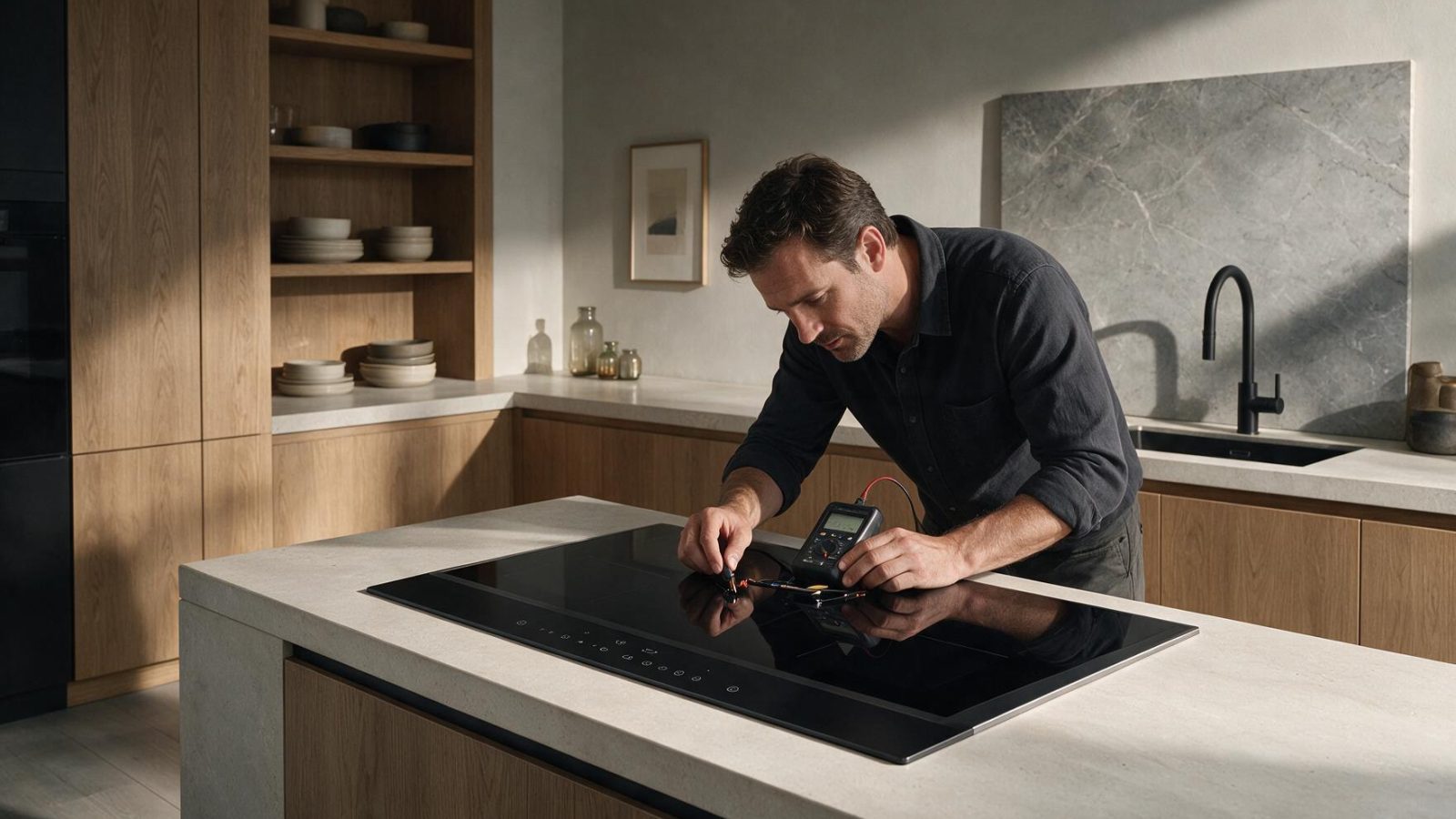

An induction zone needs compatible cookware before it can heat. If the cooktop powers on but one pan is not recognized, the fastest test is often another known-compatible pan rather than a control reset.
If an induction zone does not recognize a pan, check the cookware before anything else: it needs a magnetic, flat base that is centered on the zone. Try a pan you know is compatible, and look at the control lock and any message. If several compatible pans fail on the same zone, or there is a breaker trip, a smell or sparking, stop and book service.
An induction zone needs compatible cookware before it can heat. If the cooktop powers on but one pan is not recognized, the fastest test is often another known-compatible pan rather than a control reset.
Use cookware with a magnetic base and a bottom diameter appropriate for the zone. A simple magnet test can confirm basic magnetic compatibility, but construction quality and base size still matter. Center the pan on the cooking area and remove any protective mat or accessory not approved for induction use.
The induction manual for one Bertazzoni rangetop says each zone has pan detection that blocks heating until a suitable pan is correctly placed, and that a symbol appears after a few seconds if the pan is unsuitable or misplaced. So a zone that stays cold is often behaving as designed. The cooktop is not failing to heat; it is declining to heat without a pan it accepts.
That manual says induction needs magnetic iron or steel cookware, and that glass, porcelain, ceramic and aluminum do not work. A magnet that sticks to the base means the pan is suitable. The US FAQ adds that cookware must be flat-bottomed and magnetic, and that aluminum or copper alone will not work.
If one compatible pan works and another does not, the cooktop may be fine. If several compatible pans fail on the same zone while other zones work, the symptom becomes more specific.
The table below sorts typical observations by what they suggest and what to check.
| Symptom | What it can point to | What you can safely check |
|---|---|---|
| Symbol appears after a few seconds | Pan not suitable, not centered or not magnetic | Try a magnetic, flat-based pan centered on the zone |
| One pan fails, others work | The pan, not the cooktop | Test the pan with a magnet and check the base is flat |
| Several compatible pans fail on one zone | A zone-specific problem | Try the same pans on other zones and report which zone fails |
| Whole cooktop unresponsive | Control lock, or a power issue | Check the lock indicator and the breaker |
| Humming while cooking | Normal operation that varies by cookware | Compare with the manual |
| Fan keeps running after switching off | Normal cooling | Wait; it should stop on its own |
The manual says pans should be flat-bottomed. A concave or convex base leaves an air gap that can overheat the glass and the inductors, and the pan should stay centered on the zone. An old pan that has warped with heat may fail to register even though a magnet sticks to it. Comparing a warped pan with a known-flat one on the same zone is a quick way to tell.
The same manual says humming during operation is normal and varies by cookware, and a fan can be heard running after the cooktop is turned off. It also describes Power mode, which runs a zone at maximum for up to 10 minutes and then drops to level 9, and Holding mode, which keeps pan bottoms near 160 F (70 C) for up to 2 hours. A residual-heat “H” shows until the surface cools below about 140 F (60 C).
A child-lock function exists on that model, activated by turning the zone 1 and 2 knobs left together until “L” appears. If the zones seem unresponsive and an L is showing, the lock may be the explanation, so check the manual for how it is cleared on your cooktop. A lock is a setting, not a failure, and clearing it as documented is the only step needed.
Check control lock and any displayed message. Perform only the normal reset procedure documented for the cooktop. Repeatedly switching the breaker off and on is not a substitute for diagnosis if the fault immediately returns.
Stop using the appliance if the zone trips the breaker, smells electrical, sparks or causes the control panel to become abnormally hot. Those conditions belong with professional service.
For electrical safety, read Electrical Warning Signs Every Kitchen Should Take Seriously. For the point where external checks should stop, see Where Homeowner Checks End and a Technician Should Take Over.
Tell the technician which zone fails, which pans were tested, whether the other zones work and any displayed error code. That makes the visit much more focused than “the cooktop is broken.”
Before testing more pans, wipe the zone surface and the pan base so that no residue sits between them, and remove any mat, trivet or accessory that is not approved for induction. Check that nothing is resting on the control area. If a zone works with one compatible pan but not another of similar size, the second pan is the likelier cause. If the same pans fail across zones, a control setting such as the lock is worth checking before assuming a hardware fault.
The manual for one Bertazzoni induction rangetop says humming during operation is normal and varies by cookware. A new noise together with a fault, a smell or a breaker trip is worth reporting.
Not on their own. The manual and the US FAQ say cookware needs a magnetic base and a flat bottom, and a magnet that sticks to the base is a quick test.
The manual says a fan can be heard after the cooktop is turned off. That is cooling, and it should stop by itself.
A magnet should grip firmly to the base of the pan; if it does not, the cookware is not induction-compatible.
The pan may be smaller than that zone's minimum size, or positioned off-center from the induction coil.
Yes — an active lock can make the cooktop appear unresponsive even with compatible cookware. Check the display for a lock icon first.
A wine cooler can recover slowly after a door is left open or a large number of bottles are loaded at once. Patience is reasonable after a known…
“Not cold enough” is a useful symptom, but a measured temperature turns it into diagnostic information.
An empty ice bin can be caused by something as simple as the ice maker being switched off after cleaning. Before assuming a valve or ice-maker module has…
Share a few details and we’ll confirm an appointment. Prefer to talk? Call us and we’ll help right away.