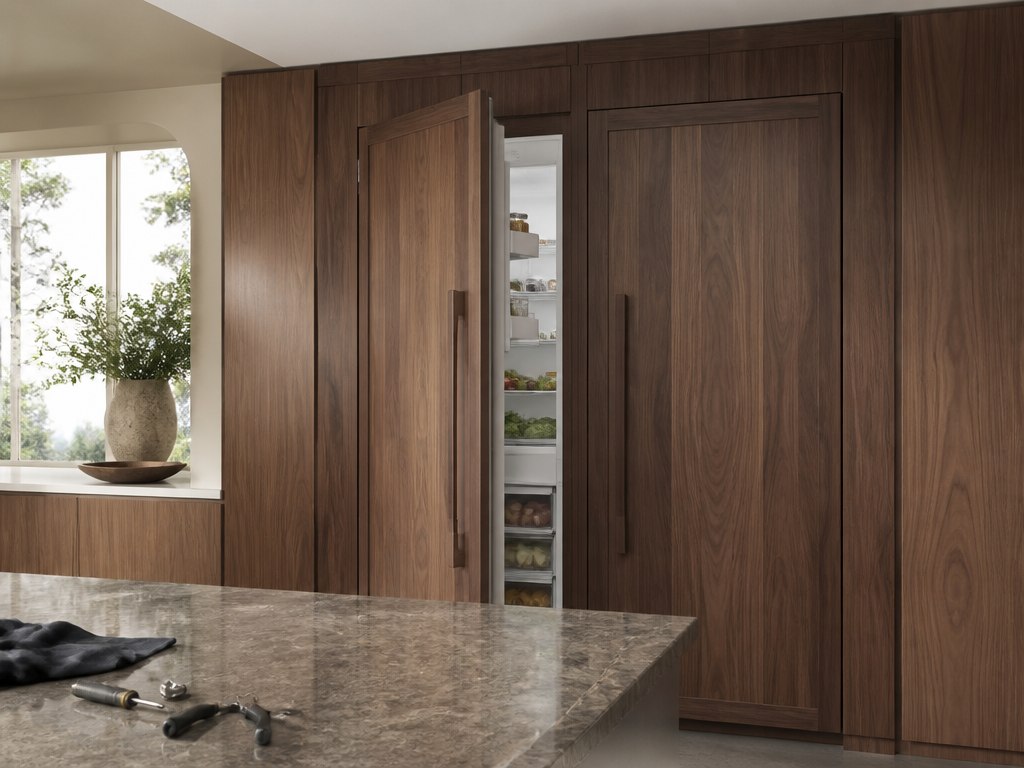

Panel-ready refrigeration is designed to disappear into the kitchen, but the installation still has to breathe and close correctly. The most useful maintenance habits are the ones that preserve those two conditions.
A panel-ready Bertazzoni refrigerator stays dependable when its door closes freely against a clean gasket and its ventilation paths stay open. Check those two conditions first, then confirm performance with a thermometer. Door alignment problems, repeated alarms, fan noise and leaks are for service.
Panel-ready refrigeration is designed to disappear into the kitchen, but the installation still has to breathe and close correctly. The most useful maintenance habits are the ones that preserve those two conditions.
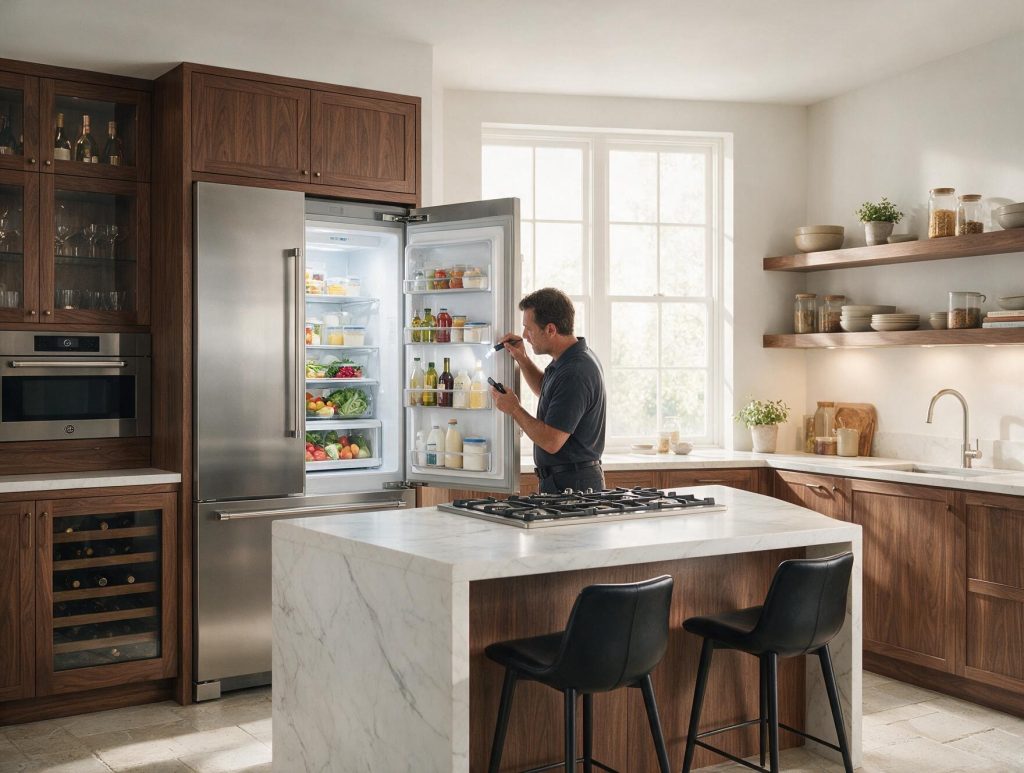
Start with the door. A decorative panel adds weight and changes how alignment is perceived. If the refrigerator starts needing an extra push to close, inspect for stored items interfering with the door and check whether the gasket meets the cabinet evenly. Do not adjust hinges or panel hardware unless the appliance documentation clearly treats that as a user procedure.
Keep the gasket clean and dry. Crumbs, syrup and cooking residue can create small gaps. A soft cloth and the approved cleaner are usually enough; aggressive chemicals can damage gasket material or finished panels.
The use manual for one Bertazzoni built-in refrigerator lists several things as normal: compressor start-up noise, sounds of liquid or gas flowing, a fan whistle, and warm front edges that prevent condensation. A fridge that has just restarted after a power cut may also stay quiet for a short while, because the manual says the compressor’s overload protector waits about six minutes before restarting. If it has not restarted after that, the manual says to call service.
Next, protect ventilation. Built-in refrigerators depend on specific inlet and outlet paths. A toe-kick opening hidden behind a new rug, stored boxes or decorative trim can reduce airflow and raise operating temperatures. Keep those paths open and vacuum only the accessible areas described in the manual.
Inside the cabinet, avoid packing food directly against air outlets. Good circulation helps the appliance maintain a uniform temperature and reduces the chance that one shelf feels warm while another is very cold.
The table links a few observations to what they can suggest and a safe check.
| Symptom | What it can point to | What you can safely check |
|---|---|---|
| Door needs an extra push to close | Items in the way, a dirty gasket or an alignment change | Clear the door path and clean the gasket; leave hinges alone |
| Front edges feel warm | Condensation prevention described as normal on this series | Compare with the manual before worrying |
| Fridge warm on one shelf | Food against an air outlet or the sensor | Move items so they do not touch the sensor or vents |
| Not cold at all, no cooling noise | A special mode or a cooling fault | Check whether a mode such as showroom is active, then compare with a thermometer |
| Odor inside | Open food or residue | Wash with a baking soda and water solution and store food in closed containers |
The same manual gives a fresh-food range of 35 to 46 F with 39 F recommended and 41 F as the factory default, a Fresco compartment between 30 and 41 F, and a freezer range from 5 to -11 F with 0 F as the default. Food must not touch the temperature sensor in the fresh-food compartment, or it cannot hold the set temperature, and hot food should not go in.
Special modes also change behavior. Eco Mode sets about 46 F and 5 F, Vacation Mode sets the fridge to 62 F, and Showroom Mode turns cooling off, so food stays at room temperature until the unit is power-cycled. Sabbath Mode switches off lights, buzzers and display panels. If a refrigerator seems oddly warm or dark, check the mode before assuming a fault.
A decorative panel adds weight, so a door that used to swing shut can start to feel different over time. Watch for a door that stays slightly ajar, or a gasket line that no longer looks even along its length. Items stored in the door bins can also keep it from sealing, which is easy to rule out by emptying the bin that sits nearest the hinge side and trying again. Hinge and panel adjustments are not an owner task unless the documentation says so, and a misaligned door that cannot be fixed by clearing its path should go to service.
The manual says to clean the condenser every six months with gloves and without a vacuum cleaner, and to check and clean door seals regularly. It also calls for at least 12 inches from ranges, ovens and other heat sources, with room temperature of at least 50 F. If cabinetry or a nearby appliance has changed, those distances are worth rechecking.
After any cleaning or loading change, verify performance with a thermometer rather than by touch. If temperatures remain unstable, see Before You Book a Fridge Repair, Get an Actual Temperature Reading. For more detail on sealing and ventilation, read Coil and Seal Care for a Bertazzoni Refrigerator.
Door misalignment that prevents sealing, repeated temperature alarms, fan noise, water leaks or persistent warming after the basic checks should be diagnosed professionally. Protect the cabinetry by leaving the appliance installed until the technician determines how it should be accessed.
The manual for one Bertazzoni built-in model lists warm front edges as normal because they prevent condensation. A warm cabinet interior is a different matter and should be checked with a thermometer.
One possibility is Showroom Mode, which turns cooling off until the unit is power-cycled according to the manual. If cooling does not return, or you cannot find a mode that explains it, book service.
The manual for one model says the compressor’s overload protector waits about six minutes before restarting after a power cut or unplug. Call service if it still has not restarted after that.
Losing cooling, building frost, or pooling water? We diagnose Bertazzoni refrigerator faults and restore reliable, efficient cooling.
Bertazzoni refrigerator diagnostics and repair — cooling loss, frost, leaks and dispenser faults.
Built-in units rely on a specific, designed airflow path through cabinet vents; freestanding units have more open airflow around them.
Yes — a panel that does not sit flush can let warm air in at the edge even if the appliance's own seal is intact.
Check the installation guide first; if adjustment does not resolve it, a technician familiar with built-in installations should handle it.
A built-in wine column performs best when the environment around it is as stable as the temperature inside it. Good care is less about frequent “deep cleaning” and…
Refrigerator maintenance is mostly about helping the appliance move heat and keep cold air where it belongs. On a built-in Bertazzoni refrigerator, that means paying attention to door…
Cloudy glasses can come from two very different causes: removable film or permanent etching. Before changing detergent, rinse aid and water-softener settings all at once, start with the…
Share a few details and we’ll confirm an appointment. Prefer to talk? Call us and we’ll help right away.